



Extending the MdynamiX HiL Test Bench Family
MXsuspensionHiL: HiL Test Bench for Suspension System Validation and Development
MXsuspensionHiL is a Hardware-in-the-Loop (HiL) test bench for the validation and development of suspension systems. It enables engineers to test real components within a fully dynamic, closed-loop simulation environment, bridging the gap between purely virtual development and physical prototyping.
At its core, the system is designed to reproduce realistic road excitation and vehicle dynamics behaviour with high fidelity. Suspension components such as dampers and top mounts, as well as passive and active complete axle systems, can be evaluated and tested under controlled yet highly dynamic extreme conditions. This approach accelerates development cycles and reduces the dependency on costly vehicle prototypes.
Closed-Loop Testing: Real Hardware in a Virtual Vehicle
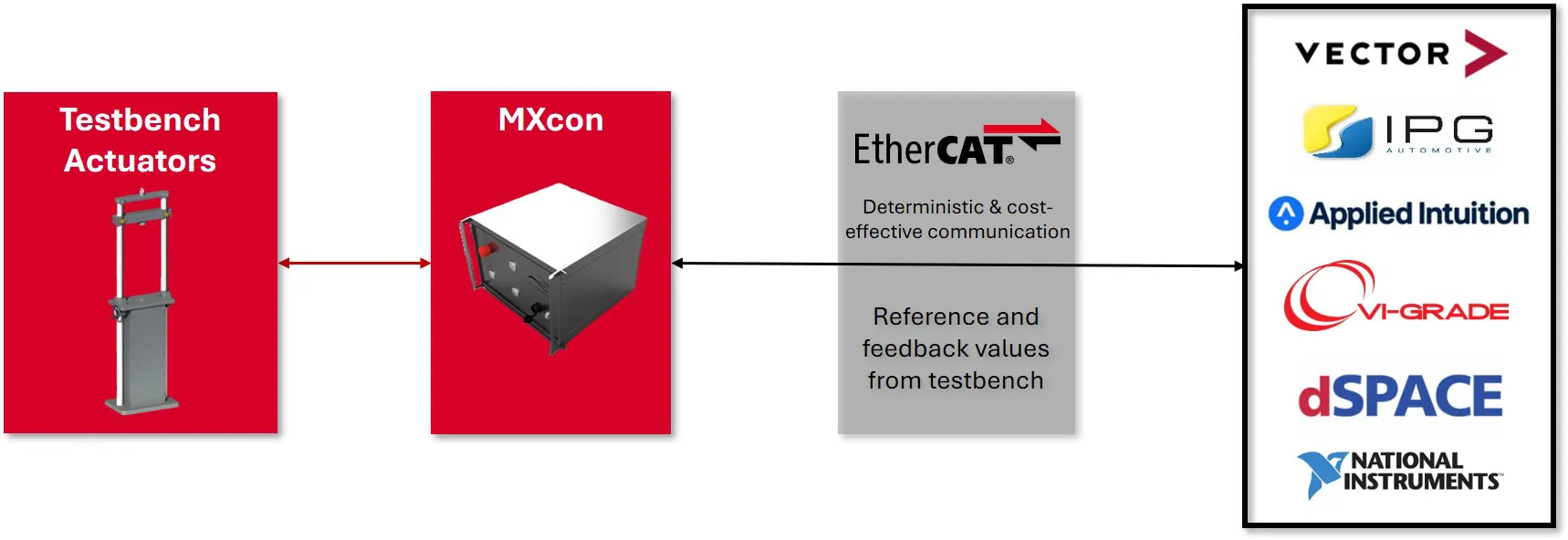
Built on MdynamiX’s modular HiL architecture, the system integrates seamlessly into existing test benches and simulation environments. MXsuspensionHiL enables true closed-loop testing, in which physical components interact with virtual vehicle models in real time. EtherCAT provides deterministic high-speed communication between all system components, so that all commercially available vehicle simulations can be used.
End-to-End Workflow: Closing the Loop Between HiL and DiL
Highly Dynamic Electric Linear Actuator Technology
At the heart of MXsuspensionHiL is a high-performance electric linear actuator system delivering precise force and displacement control across a wide frequency range up to 110 Hz.
- High bandwidth for transient road excitation
- Accurate force and displacement control
- Exceptional repeatability for reliable results
- Ideal for high-frequency suspension dynamics
This captures real-world effects that conventional systems miss.
Damper Characterization and VDA-Compliant Testing
Another central capability of MXsuspensionHiL is the characterization of dampers and suspension components in line with established industry standards. Future suspension systems can be developed with confidence using standardized, reproducible test methods:
- Force–velocity and hysteresis analysis
- Frequency response characterization
- Support for VDA-compliant test procedures
- Suitable for passive, semi-active and active systems
The result is comparable, high-quality data across all development stages — from component design through to system validation.
Applications: From Damper to Chassis Control
In practice, MXsuspensionHiL is used across a wide range of development tasks. These include the validation of passive, semi-active and active suspension systems, the development of chassis control strategies, and the evaluation of ride comfort and durability. Its ability to combine real hardware with virtual vehicle models makes it particularly valuable in early development phases, where design decisions have the greatest impact:
- Suspension system development
- Chassis control system validation
- ADAS and vehicle dynamics testing
- Component durability testing
- NVH and ride comfort analysis
Key Facts of MXsuspensionHiL
- True closed-loop testing: physical components interact with virtual vehicle models in real time
- High-performance electric linear actuator system with precise force and displacement control across a wide frequency range up to 110 Hz
- Deterministic high-speed communication via EtherCAT: all commercially available vehicle simulations can be used
- Seamless integration into existing test benches and simulation environments thanks to a modular HiL architecture
- Characterization of dampers and suspension components to established industry standards, including support for VDA-compliant test procedures
- Suitable for passive, semi-active and active systems
Benefits for Development Engineers
- Accelerated development cycles and reduced dependency on costly vehicle prototypes
- Real-world effects captured that conventional systems miss
- Comparable, high-quality data across all development stages
- Reliable development through standardized, reproducible test methods
- Design issues identified in early development phases, before they become expensive