


Cooperation with Ansible Motion and rFpro
Real Steering and Braking Hardware, Live in the Driving Simulator
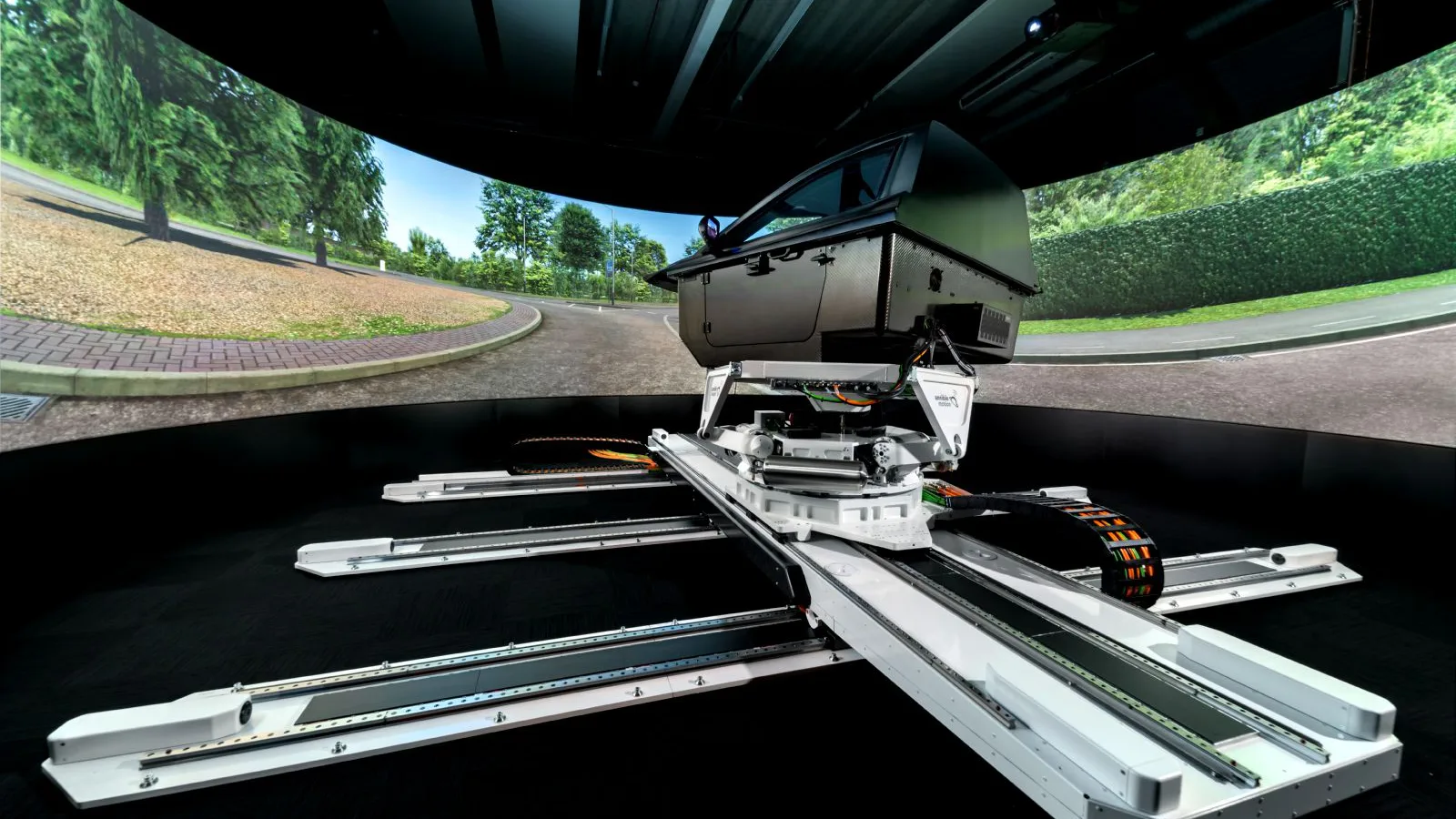
MdynamiX and Ansible Motion run physical steering systems inside the Driver-in-the-Loop (DIL) environment. Real steering units, their ECUs and control software operate natively in the simulator loop — measured rather than modelled — across every Ansible Motion DIL cabin and both fixed-base and motion platforms. The capability continues a long-standing partnership built on combining real and virtual systems for early-stage steering development.
How native HiL integration works – both steering and braking
Rather than substituting software stand-ins for the steering system, the setup places the real components — ECUs and governing code included — directly into the simulation. The driver feels the genuine unit, its torque response captured from hardware rather than computed. MdynamiX drives this through MXsteerHiL, a real-time bench covering EPS and a range of Steer-by-Wire designs, while Ansible Motion’s open architecture allows the hardware to integrate cleanly into both stationary and moving DIL platforms without compromise.
The same principle extends to braking. MXbrakeHiL places a full physical brake assembly — from pedal to caliper — directly in the loop, reproducing the hydraulic and friction behavior that simulation models struggle to capture. ESC ECUs, ABS and Autonomous Emergency Braking are validated against real hardware, not a representation of it.
Key Facts at a Glance
- MdynamiX MXsteerHiL drives EPS and multiple Steer-by-Wire systems in real time, directly in the loop.
- MXbrakeHIL
- Real components, not models: genuine steering hardware, ECUs and software, fully integrated into Ansible Motion’s static and dynamic DIL ecosystems.
- Coverage: all Ansible Motion DIL cabin variants and simulation environments.
Benefits – What engineers gain
Putting the actual parts in the loop, rather than a representation of them, opens up:
- Steering feel tuned by hand from authentic torque behaviour and feedback, not an estimate
- Braking ECU application and calibration, repeatable under controlled laboratory conditions
- Virtual tire development with steering that responds the way it would on the road
Models carry an assessment only so far. The moment a decision rests on the driver’s own judgement of feel, real hardware is what bridges the gap — and that is precisely where this method earns its place.
Impact on the development cycle
Effective virtual development is a matter of balance: deciding which parts of a vehicle to run as real hardware and which to compute, weighed against the design, the test programme and what components exist at that point. Pairing Ansible Motion’s adaptable DIL architecture with MdynamiX’s end-to-end steering and braking methodology lets OEM teams settle questions earlier, iterate faster and assess a wider set of vehicle attributes before any physical prototype is built.
It also shifts work off the track. Proving-ground testing is costly and slow, and hinges on prototype availability, weather and resource allocation. With real steering components inside the simulator lab, far more of that investigation moves into the virtual domain — without giving up the genuine physical response of the system.
Native rFpro integration for authentic haptic feedback
MdynamiX haptic hardware is designed to further enhance the Ansible Motion and rFpro environment. In an Ansible Motion driving simulator, rFpro supplies both the simulated world and the models that bring the simulation to life. The MdynamiX feedback hardware, comprising MXsteerWheel RTpro and MXbrakePedal, is natively integrated into Ansible Motion driving simulators and runs seamlessly within the rFpro environment. Together, rFpro’s lidar-compatible road surfaces and deterministic vehicle dynamics provide users with authentic haptic feedback across every use case.
MdynamiX feedback solution in the rFpro environment
- MXsteerWheel RTpro — stable, high-resolution force feedback for steering and ADAS/AD work; evaluates steering feel, torque overlays and lane-keeping against rFpro’s deterministic vehicle dynamics and road surfaces.
- MXbrakePedal — detailed brake-pedal response for DIL, conveying ABS vibration, regenerative blending and emergency-braking transitions for earlier braking-strategy validation across different use-cases or weather conditions.
- Photo-realistic, lidar-grade environments; repeatable low-latency feedback; iconic circuits including Nardò, Nordschleife and Hockenheim; a scalable DIL workflow that lowers cost, risk and time-to-market.

Interested?
Talk to us about HiL/DiL control integration.
Header photo credit: Ansible Motion Delta S3 DIL simulator with integrated Mdynamix steering systems, Ansible Motion Ltd.