


 Automated Driving - ADAS/AD | Research
ADAS validation through mixed reality
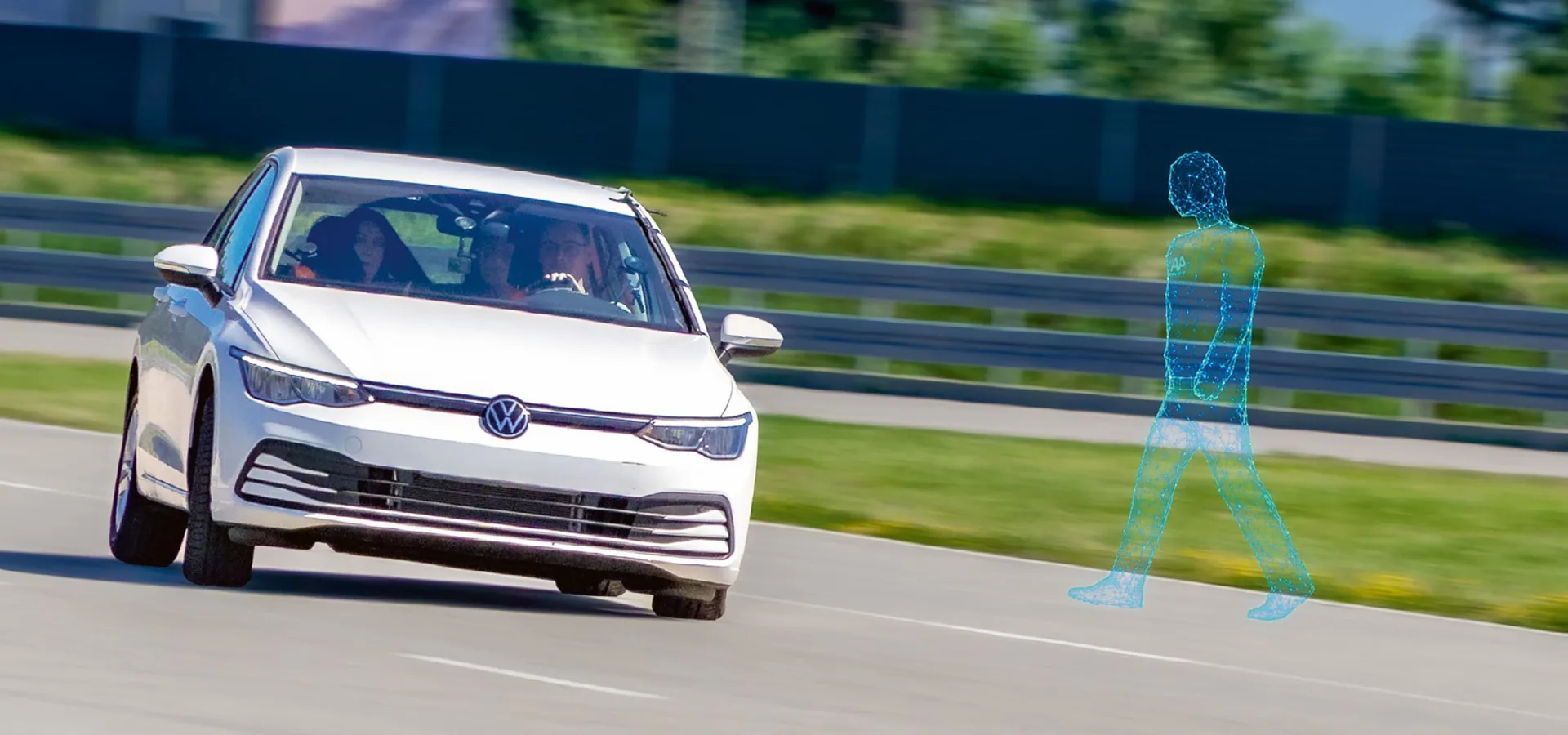
As Euro NCAP and homologation requirements become increasingly demanding, the effort required to validate advanced driver assistance systems (ADAS) continues to grow. An increasing number of complex scenarios must be tested reproducibly under varying environmental and traffic conditions. Conventional driving tests involving physical targets, test dummies or multiple real vehicles are increasingly reaching their limits in terms of effort, cost and safety.
Mixed reality combined with Vehicle-in-the-Loop (ViL) brings together real-world driving tests and virtual traffic scenarios. A real vehicle operates on the proving ground, controlled by a driving robot and connected to a real-time simulation. Additional vehicles, pedestrians and infrastructure elements are integrated virtually into the test environment. This allows critical maneuvers such as cut-in, cut-out, lane changes and slalom tests to be performed safely, under controlled conditions and repeated as often as required – even at distances as close as 0 m to virtual objects. Swarm tests combining real and virtual vehicles are also possible with less physical testing effort.
The technical article “accelerated validation of driver assistance aystems through mixed reality” demonstrates how this approach has been implemented in practice and explores its potential for ADAS validation. The article was developed in collaboration between IPG Automotive, the Institute for Driver Assistance and Connected Mobility (IFM) at Kempten University of Applied Sciences and MdynamiX AG.
Accelerated validation of advanced driver assistance systems with mixed reality
Authors:
Jan Oberst, Henning Kemper, Michael Pohl, Adrian Günther
Read the full technical article here:
ATZ 10–11/2026, Springer Professional (German)
IPG Automotive (English)