


 Vehicle Dynamics + Steering | News
Why isn’t simulation alone enough to reliably assess ride comfort?
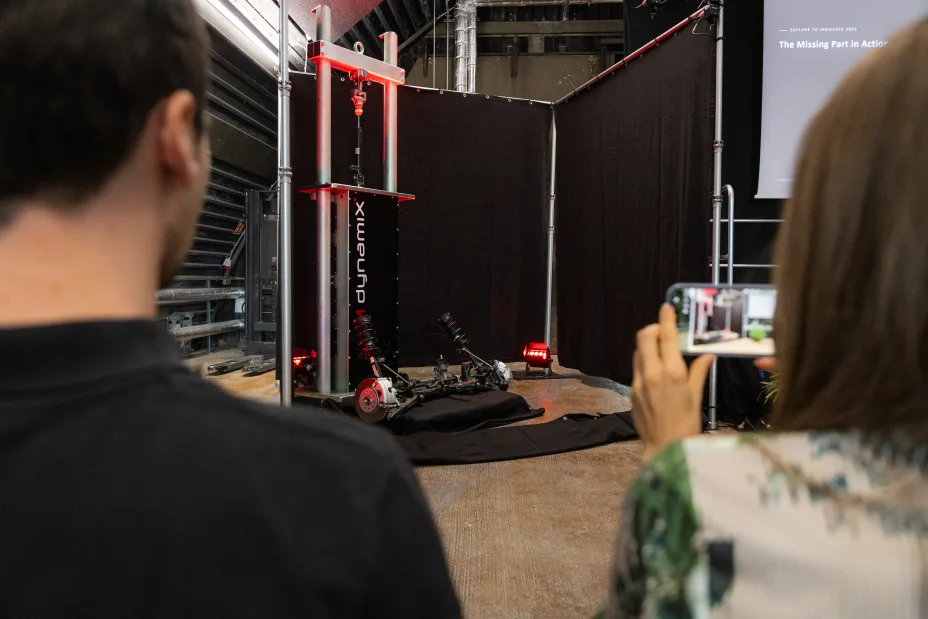
MXsuspensionHiL is a hardware-in-the-loop (HiL) test bench that integrates real suspension components — dampers, strut mounts, entire axles — into a real-time vehicle simulation. Unlike a conventional damper test rig, which runs predefined displacement or velocity profiles, it operates in a closed control loop with a vehicle model: the damper force changes the simulated body motion in real time, and that motion determines the next excitation — so the system responds the way the real vehicle would.
Why real hardware instead of pure simulation?
Dampers and mounts behave in a highly nonlinear way: hysteresis, friction, gas and oil compressibility, temperature drift, and valve dynamics can only be captured in a model with significant effort and residual uncertainty. In a real component, these effects occur physically — with no parameterization required.
The right bandwidth for component testing ride comfort
Bandwidth is what matters for comfort assessment: body movement (around 1 Hz) and wheel movement (around 10 to 15 Hz) oscillate at relatively low frequencies, but damper noise, break-away behavior, and valve noise only show up above 20 Hz. MXsuspensionHiL covers this comfort-relevant range — including higher-frequency phenomena up to 110 Hz — on a single test bench, and connects via an EtherCAT interface to Vector DYNA4, IPG CarMaker, VI-grade Autohawk, or dSPACE ASM.
The MX test bench family is growing
MdynamiX’s HiL test bench family has grown: the MXsuspensionHiL made its first public appearance in July at Explore to Innovate 2026 near Memmingen, the joint event held by IFM (Institute for Driver Assistance and Connected Mobility) and MdynamiX.
Developing suspension components and want to know how the MXsuspensionHiL fits into your test process? Talk to our team — we’re happy to walk you through the test bench in detail.