


 Automated Driving - ADAS/AD | Research
Technical Capability Is Not Enough: FIA-Commissioned Study Reveals the Human Factors Behind ADAS Safety Impact
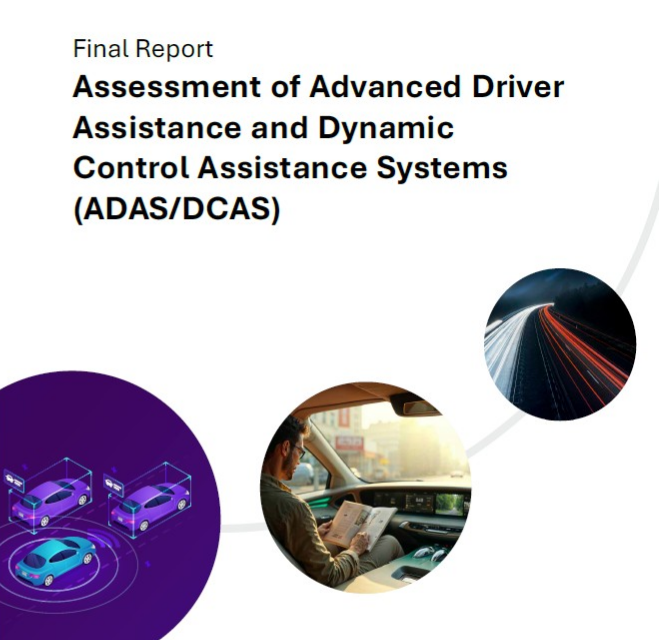
ADAS have reached a high level of technical maturity and are widely available across Europe — but does technical availability actually make roads safer? To answer this, FIA Region I commissioned IFM – Institut for Driver Assistance and Connected Mobility and MdynamiX to conduct a KPI-based, data-driven study from April to December 2025. The research team — Gioele Micheli, Prof. Dr. Uwe Stratmann, Florence Wagner, Prof. Bernhard Schick, and Prof. Dr. Rolf Jung — combined a structured literature review, public dataset evaluation, and a European customer survey with over 13,000 participants across six or more countries.
Key Findings
The study’s central insight: human factors determine safety impact. A system can only impact road safety if drivers trust and consistently use it. Adaptive Cruise Control (ACC) demonstrates this well — high trust, high usage, and a clear positive safety contribution. Lane-Keeping Assistance (LKA), by contrast, suffers from lower trust and usage rates, leaving much of its safety potential unrealized.
Both systems also show performance gaps in exactly the conditions where safety matters most: rural roads and adverse weather. Across countries, a clear pattern emerges — higher ADAS effectiveness correlates with informed users, supportive infrastructure, and fleet characteristics that enable proper system use.
Conclusion and Policy Implications
Technical availability does not equal real-world safety impact. For ADAS developers, the key question is no longer just how well a system performs — but whether it is designed around the user sufficiently. For policymakers, the study points to driver education, infrastructure investment, and furthering frameworks that standardize ADAS behavior and UI as essential levers. The full report, now publicly available, provides a comprehensive evidence base for all stakeholders working to turn ADAS potential into measurable safety gains on Europe’s roads.
Full report available at the FIA Region I website: Final_Report_ADAS_DCAS_FIA_2025.pdf
About the Project
Study conducted April–December 2025 by IFM and MdynamiX on behalf of FIA Region I. Team: Gioele Micheli, Prof. Dr. Uwe Stratmann, Florence Wagner, Prof. Bernhard Schick, Prof. Dr. Rolf Jung.
The findings of the FIA study reflect the core of our work: safety only emerges when people and systems fit together. In our UX + Human Factor service area, we examine exactly this interplay – from acceptance and usability to real-world usage. Learn more